Repère Architectural | News
A frameless glass door is a fine detail right up until someone asks for access control on it.
That’s where the detail falls apart. Add an electromagnetic lock at the head. Then an exit button, because the maglock has to release. Then an emergency pull station, because the code requires one. Then an electrical tie-in to the fire alarm system. By the end, the clean entrance drawn at concept is covered in hardware and wall plates.
There’s another approach: put the lock and the electric strike inside the fitting itself.
What GBI does
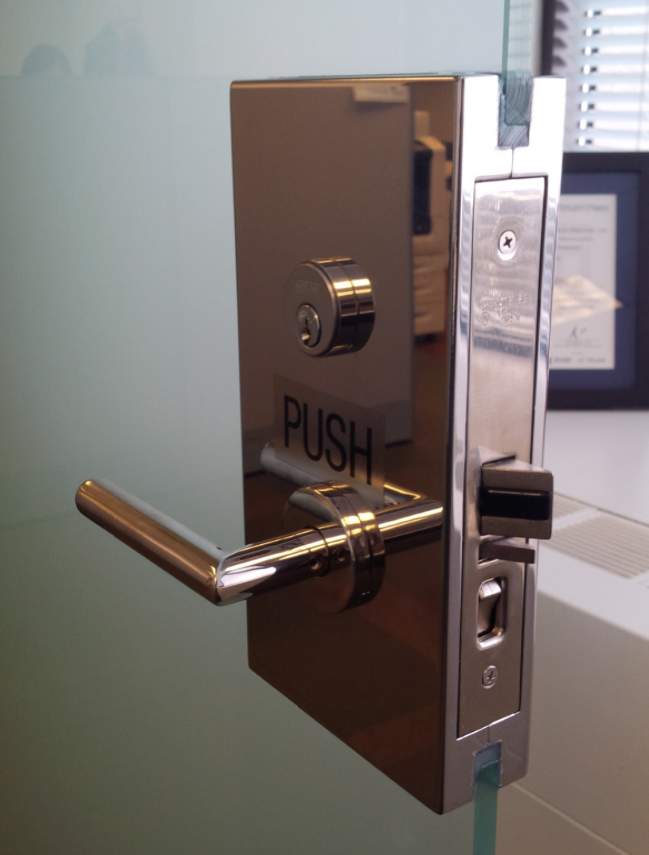
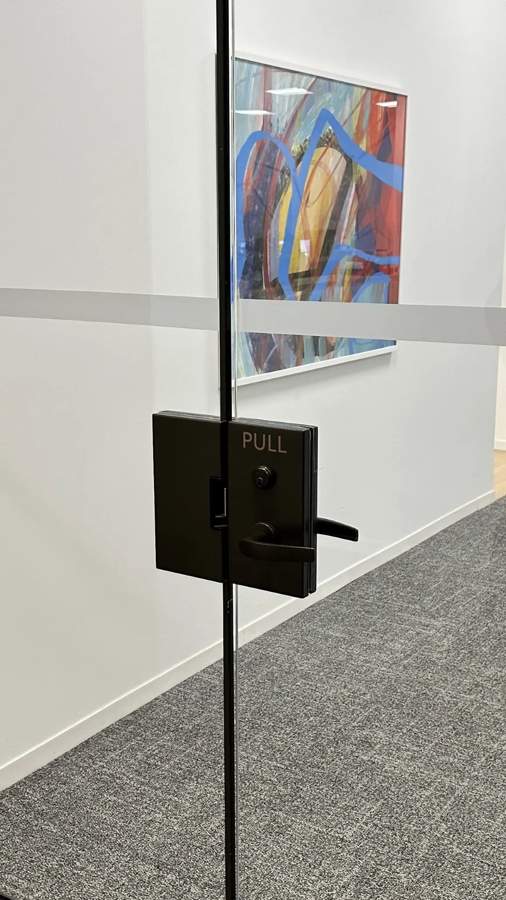
GBI Industries, based in North York, Ontario, manufactures mortise patch locks for frameless glass doors. The principle is simple. Rather than adding devices around the door, the whole function lives in the fitting that already holds the glass.
The housing. A one-piece high-density polyethylene body, clad in .050 gauge wrought brass, bronze or stainless steel. This is the main difference from competing fittings, which rely on pressure fitting or clamping. A one-piece housing doesn’t work loose over cycles.
The lock. An integrated ANSI Grade 1 mortise lock. Locking functions include a deadlatch feature for security, and deadbolt functions give a 1″ throw.
The cylinder. The locks accept most other manufacturers’ standard 1 1/8″ mortise cylinders. That means the glass door joins the building’s existing master key system, with no orphan key for the facility manager to track.
Durability. GBI uses components that far exceed ANSI Grade 1 cycle requirements.
The electric strike changes the math
This is the part that interests designers and facility managers.
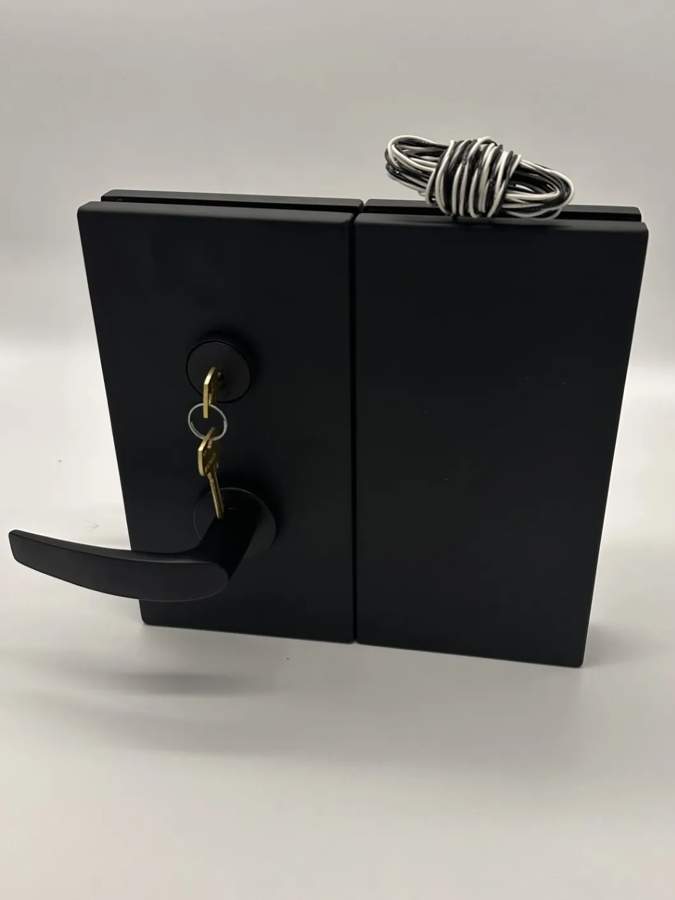
GBI patch strike boxes are available with integrated electric strikes, for access control or automatic door operator applications. The P1294-ES covers standard applications, and the P1294-ES-LM adds a latch bolt monitor where position monitoring is required. Available in 12 or 24 VDC.
The advantages over an electromagnetic lock are concrete:
No exit buttons. Egress is mechanical through the lever, like any other door.
No pull stations. There’s no electromagnetic holding device to release.
No expensive electrical tie-ins. Wiring is limited to the strike.
Works with automatic door operators. Useful at accessible entrances.
Remote unlocking. Ideal for reception doors controlled from the front desk.
And visually: nothing at the head, nothing on the wall, nothing breaking the line of the glass.
What to watch when specifying
The glass must be factory-prepared. GBI fittings are designed for 1/2″ glass with a rectangular cut-out per template. Tempered glass cannot be cut or drilled after tempering. In practice, the exact fitting position has to be settled before the glass is fabricated, not during installation. This is the most expensive mistake on this type of work, and it’s irreversible: a mis-cut panel is a replaced panel.
Get the templates early. GBI publishes templates and a handing chart. These need to be in the glass fabricator’s hands at order time, not at installation.
Confirm handing before ordering. A mortise lock is handed. Discovering a reversed hand on site means a new fitting and often a new glass panel.
Coordinate with the access control integrator. Decide early whether latch bolt monitoring is required, since that determines which strike model to order.
Confirm egress with the AHJ. Mechanical egress through the lever is generally the simplest path code-wise, but requirements vary with building use and the exit path. Confirm before finalizing.
The short version
On a frameless glass door, every device added around the opening is a compromise on the detail. GBI delivers access control, security and building master key compatibility without adding anything to the sightline.
It’s a Canadian line, with short lead times and local technical support.
We represent GBI Industries across Quebec and the Ottawa and National Capital Region. To confirm a configuration, request templates, or get specification support, get in touch.